
Blue complicity

A credible practice of marine conservation science cannot go together with complicity in genocide. Yet, we are currently witnessing over 32 months of live-streamed genocide, and marine science’s lasting association to it.

Academic complicity in (marine) science
The settler-colonial violence unleashed on Palestine today is supported and facilitated by governments, corporate entities and scientific institutions all over the world (in particular in the so-called ‘West’). Without this ecosystem of complicity, Israel would not be able to carry out the mass displacement and slaughter of the Palestinians.1 Israeli academic institutions are deeply interwoven with military industries and have been key in the development of the technological, socioeconomic, epistemological and legal infrastructure of occupation and genocide.2 In academic collaborations it is therefore “impossible to disentangle the expertise that Israeli partners contribute to these partnerships from that gained and used in violations to which they are connected”.3 In Europe, one of the main research funding bodies is Horizon Europe. Against the backdrop of countless blatant human rights violations, Israeli public and private entities are still allowed to partner in Horizon Europe projects through the EU-Israel Association Agreement, despite global calls to suspend it (including by the United Nations).4 The Israeli regime’s flagrant violations of international humanitarian law would never have been possible if the international community, including the EU and its academic institutions, had held Israel accountable for its actions and taken appropriate measures in response.
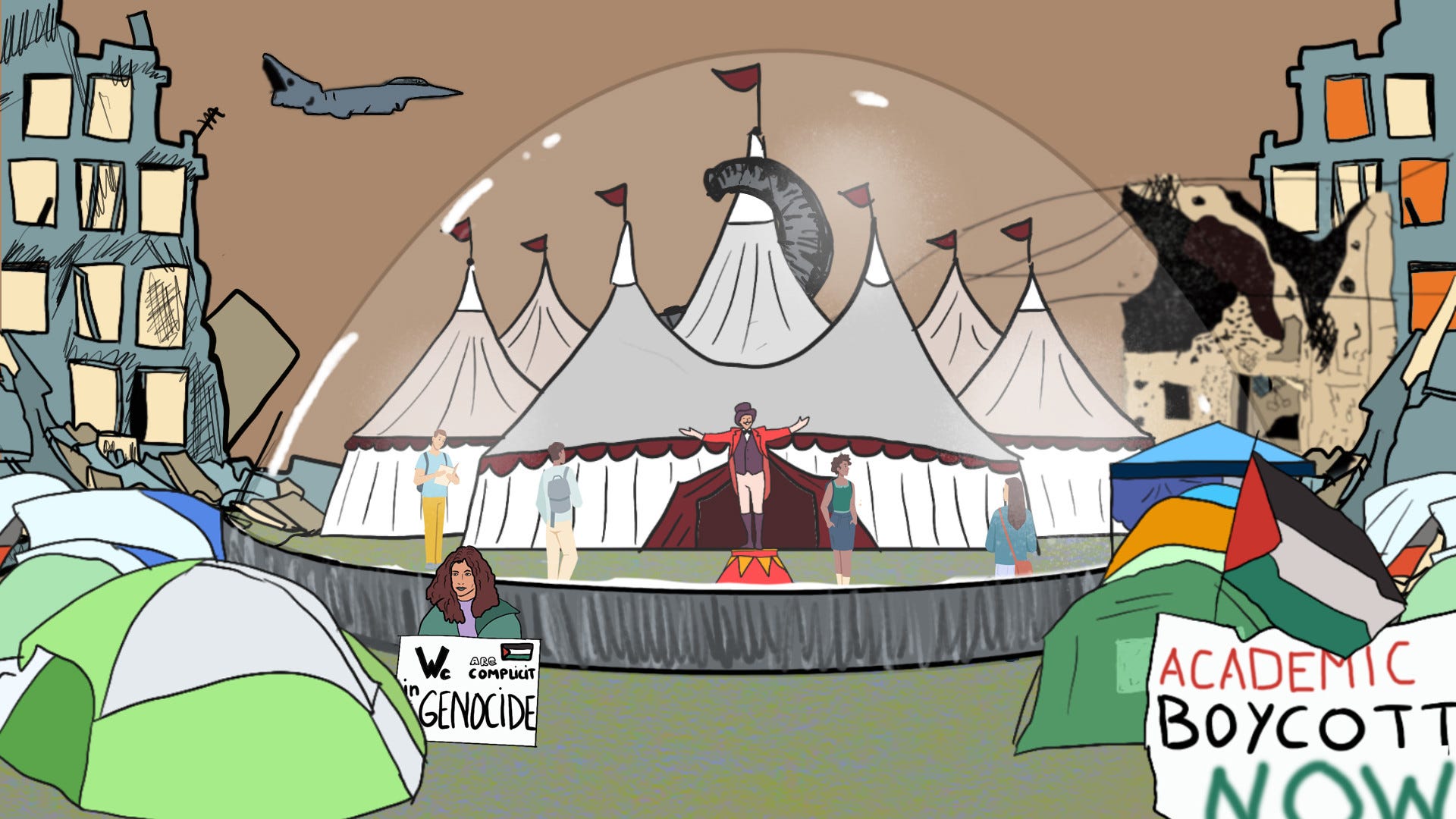
Illustration by Fourate Chahal El Rekaby. Source: 'The circus of academic complicity’ by Gert Van Hecken on Transnational Institute (2025).
Marine-themed Horizon Europe projects fall under Mission Ocean, a program by the European Commission aiming to ‘restore our oceans and waters’.5 Mission Ocean beneficiaries include Israeli ministries, an arms manufacturer,6 as well as universities tightly interwoven with the Israeli economy of occupation and genocide (in manifold and diverse ways, but most obviously through arms development and military collaborations). Seventeen active Mission Ocean projects involve Israeli partners, as well as some of the most renowned European marine science institutions.7 For Belgium alone - the country where we write from – we could find eight international projects involving Belgian marine research groups and Israeli partners (see table below). Additionally, it is deeply cynical that marine science institutions happily frame their supposed research relevance within the United Nations’ Sustainable Development Goals, but neglect the United Nations’ repeated calls for a global boycott and an end to institutional and corporate complicity in apartheid and genocide.8 Moreover, marine scientists actively publicise European Commission President Ursula von der Leyen’s interest in their research, as a way of displaying their ‘policy impact’.9 Since 2024, von der Leyen is under investigation for her complicity in grave violations of international humanitarian law.10 The complaint scrutinises how von der Leyen’s unconditional support to Israel – military, economic, diplomatic and political – has enabled war crimes and the ongoing genocide in Gaza. In the same week that marine researchers listened to her uninspired speech at the UN Ocean Conference in June 2025, she phoned Benjamin Netanyahu (fully aware he is under an International Criminal Court arrest warrant) to reiterate ‘Israel’s right to defend itself’ (fully knowing he understands this as a pat on the back for his extermination policy).11 Marine science institutions cannot claim to be apolitical whilst advertising their political associations. There is no academic ‘neutrality’ in the face of repression, colonialism and genocide.
Table 1 Ongoing projects in which Belgian marine research groups partner with Israeli institutions.12 Acronyms stand for: IUI - Interuniversity Institute for Marine Sciences in Eilat; IOLR - Israel Oceanographic and Limnological Research; VLIZ – Flanders Marine Institute; KULeuven – Katholieke Universiteit Leuven; RBINS - Royal Belgian Institute of Natural Sciences; ILVO - Flanders Research Institute for Agriculture, Fisheries and Food.
Scientists in particular should be horrified that the very act of learning, researching and archiving is a target of eradication. “The deliberate targeting of our educational infrastructure is a blatant attempt to render Gaza uninhabitable and erode the intellectual and cultural fabric of our society,” Gaza academics write in an open letter.13 In this scholasticide Israel has murdered students and teachers, and has destroyed university and school infrastructure (with 92% of schools in Gaza requiring complete reconstruction).14 Does it still matter to mention that under international humanitarian law it constitutes a war crime to target even one school? Or one university or one museum or one library or one hospital or one ambulance or one fishing boat or one farm or one desalination plant or one sewage plant or one mosque or one cemetery?
Does it still matter to mention these well-known facts? Can this already well-known knowledge still bring knowledge institutions to answer the calls to refuse complicity?
In May 2026, the Belgian Universities for Palestine reiterated the demand of staff and students to end complicity.15 In 2024, Lowell Iporac called for resisting the “normalization of genocide in academia and conservation”, specifically addressing marine conservation scientists: “The scientists’ responses to the occupation of Palestine, especially in light of the genocide in Gaza, is a litmus test of the consistency (or hypocrisy rather) of scientists and their institutions’ commitment to social justice and decolonization.”16[
We seek to resound these calls.
Green genocide – the ecological dimension of ethnic cleansing
Genocide is a total enterprise: it aims to eradicate a people, but also to erase the living culture, scholarship, histories, landscapes and ecosystems that sustain it.17
The environment plays a key role in settler colonialism. Settler-colonial extermination wars are biopolitical wars, which deliberately disrupt the indigenous population’s historical, spiritual, symbolic, economic and ecological relation to its environment.18 A highly militarised society necessarily militarises the land- and seascape. Even before its bombs and bullets cause wide-spread devastation, the Israeli military-industrial complex impacts the environment through its extensive military infrastructure, the development of (nuclear) weapons and military training sites contaminating the soil with heavy metals and other pollutants. The (para)military occupation of Palestinian land includes the deliberate uprooting of people, flora and fauna, and the bulldozing of wild, agricultural and residential areas.19 In Gaza, the widespread devastation since October 2023 amounts to ecocide. You don’t need an ecology degree to understand that a years-long indiscriminate bombing campaign constitutes an environmental disaster: landscapes are obliterated, attacks on water and waste water infrastructure cause the outbreak of disease and pollution, explosives chemicals (including white phosphorus and depleted uranium) impact the soil, air and water...20 Even during the current ‘ceasefire’ since October 2025, Israeli military continue to destroy lands and lives.
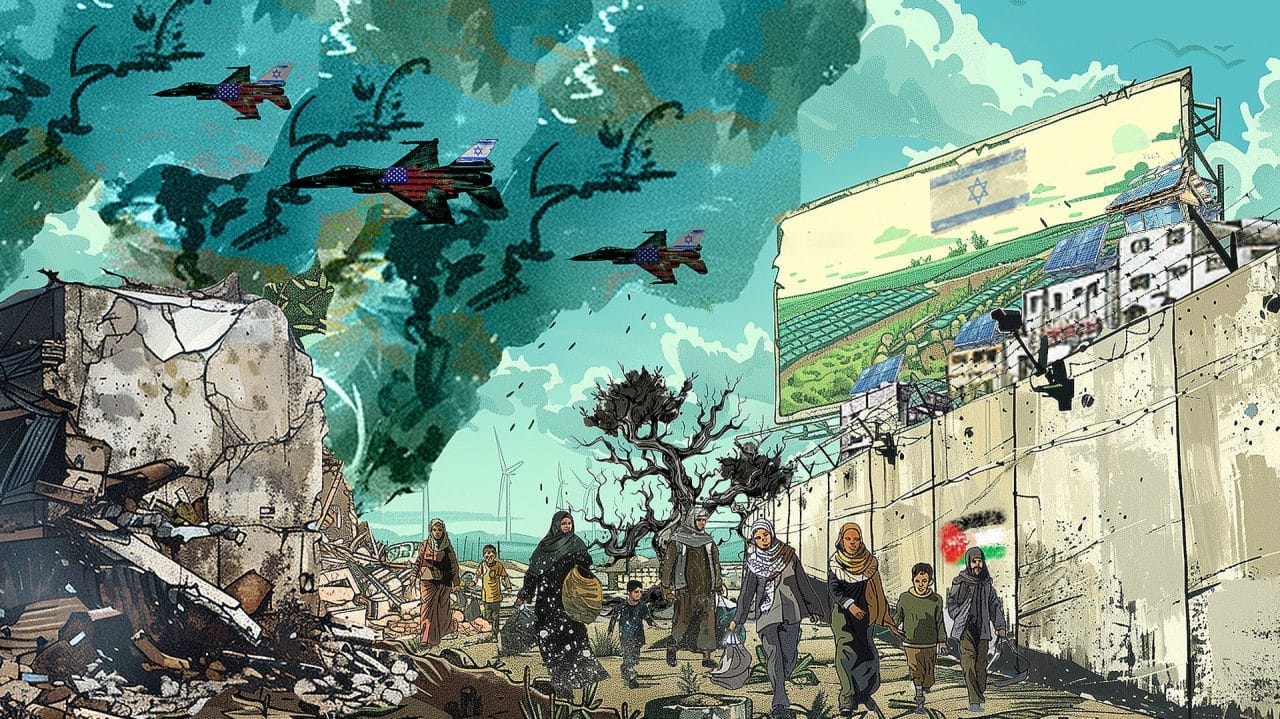
Illustration by Fourate Chahal El Rekaby. Source: ‘Ecocide, Imperialism and Palestine Liberation’ by Hamza Hamouchene on Transnational Institute / Mondoweiss (2025).
A key aspect of genocidal warfare is thus environmental destruction, but so is environmental ‘conservation’. So-called ‘nature reserves’ are instrumentalised for the displacement of Palestinians and for Europeanising and de-historicising the landscape, which involves the erasure of indigenous relations to more-than-human beings and the introduction of species that fit the Zionist vision of the land.21 To reify the green colonial imagination of a space, the indigenous land use is both invisibilised (e.g. by labelling agricultural areas as ‘open space’) and criminalised as an existential threat to the ‘natural integrity’ of the ‘protected’ area, thus legitimising the arrest and assault of Palestinians accessing or working the land.22 Half of the areas that Israel allots as ‘nature reserves’ in the West Bank are also designated for military and settlement use.23 “Settler colonialism destroys to replace”.24 The pine tree is planted where the olive tree is uprooted. The Israeli conservationist, soldier or settler is sustaining the ‘nature reserve’ where the Palestinian is being displaced. Environmental erasure and ‘conservation’ are complementary ways of weaponising the environment: they are two sides of the same colonial coin.
This model of green militarism is exported beyond Palestine. In similar ‘conservationist’ land grab schemes in several African countries, indigenous peoples are displaced and criminalised as ‘poachers’ or ‘terrorists’, legitimising their murder. The shoot-to-kill policy is employed by park rangers who receive paramilitary training by Israeli companies and military forces in partnerships with major NGOs such as WWF, the Wildlife Conservation Society and African Parks.25 In Indian-administered Kashmir the Israeli settler colonial model is replicated in a violent and highly militarised attempt to replace the indigenous land use with a reimagined environment (involving the transfer of Israeli water and agricultural technology, which has been instrumentalised for greenwashing the attempted erasure of both Palestine’s and Kashmir’s indigenous populations).26 All the while Israel trades and provides in military personnel, equipment and training to (para)military across the world who target indigenous peoples and environmental activists.27
Beyond the land, the cynicism of marine conservation in a militarised, settler-colonial context can be illustrated by the Yam Shikma Marine Nature Reserve, and its mere geographical position. The ‘reserve’ borders the illegal wall around Gaza and is located about 10 kilometres from Shikma prison. It is about 5 kilometres from Beit Lahiya in northern Gaza, where Israel relentlessly commits massacre after massacre and has obliterated the vast majority of infrastructure.28 It is where a ‘ceasefire’ does not stop the Israeli military from drone striking aid workers and journalists or from shooting children attending classes in tents.29 The ‘reserve’ itself served as a military zone after October 2023.30 How is the marine life this reserve is supposed to preserve, living through this? Are there still local green sea turtles alive who witnessed the arrival of the Nakba on those coasts in November 1948? Do fish gills now clog with bomb dust? Do the common dolphins’ acoustic senses register the tortured cries from the prison? Do the octopi smell the abundance of blood in the water? Does their extraordinary intelligence fathom the meaning of such concentrated cruelty?
Needless to say – or conversely: necessary to repeat - there is no such thing as an apolitical collaboration in conservation science.
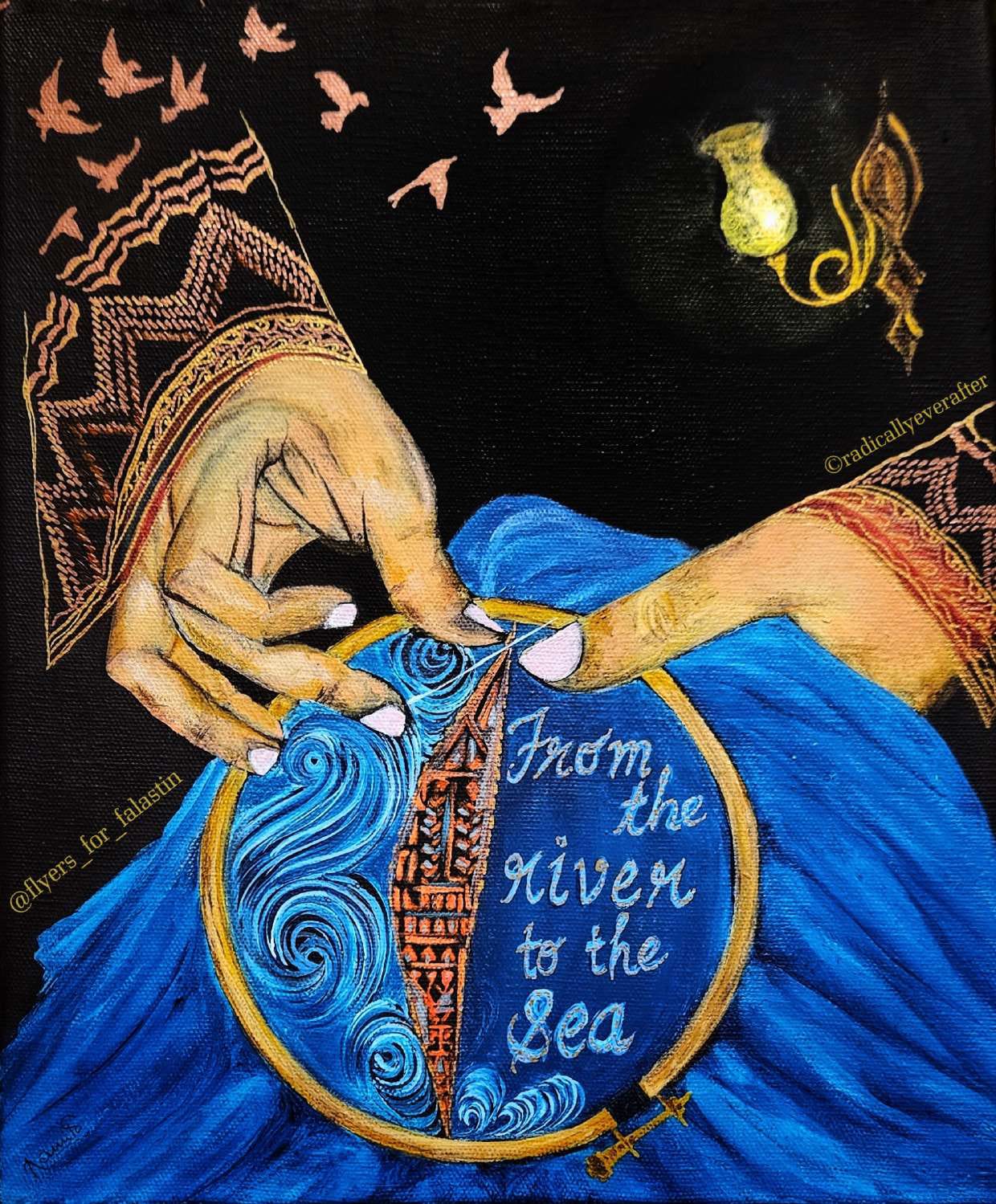
Illustration by @radicallyeverafter. Source: Flyers for Falastin (2024).
Resisting an occupied sea
Just like the land, the sea is a terrain of ethnic cleansing. The sea is fundamental to Palestine’s torn geography with the Gaza strip being squeezed against it and the West Bank’s severing from it. The keffiyeh’s fishnet pattern symbolises the significance of the Palestinian relation to the sea, which is under extreme duress because of the maritime occupation. The decades-long unlawful naval blockade of Gaza’s seas is violently and arbitrarily imposed by Israel. Aya Bseiso writes: “The act of fishing in a state of genocide is no longer a simple act of braving the temperament of the sea. Instead, it is a constant navigation of invisible layers of colonial occupation, exploitation and extraction, enacted upon a besieged Mediterranean sea-bed.”31 Even before the current war, Israeli military would continuously harass and attack Gaza fishers, stealing and damaging their boats and gear, and arresting fisherfolk or shooting at them.32 Since October 2023, Israel has further restricted access to Gaza’s seas, denying access altogether. Moreover, Israel’s systematic attacks on fishers and fishing boats have devastated Gaza fisheries, adding to the enforced starvation.33 Not only Gaza’s water column is occupied, but also its seabed. While Israel inhibits Palestinian access to Gaza’s offshore natural gas fields, the Israeli Ministry of Energy awarded exploration licenses in Gaza’s seas on 29 October 2023.34 Moreover, 13 nautical miles along Gaza’s coastline lies the Egyptian-Israeli El-Arish – Ashkelon pipeline, which was constructed disregarding Palestinian consent or international law.35 The sea also acts as a terrain for complicity, where international shipments (including jet fuel and weapons36) to and from Israel continue. Meanwhile, international navies are conspicuously absent in their obligation under international law to stop the genocidal siege.37
Yet, the sea is also a place of resistance and solidarity. Gaza fisherfolk continue to brave the absurdly militarised sea. Elsewhere, dockworkers and human rights organizations have blocked shipments of weapons destined for Israel.38 Port personnel have organised strikes in solidarity with Palestine. For the past 18 years, numerous civilian activist missions have sailed for Gaza to break the blockade. Since the genocide, the vessels Madleen (named after a Gazan fisher39) and Handala, as well as two Global Sumud Flotilla missions, have attempted to reach Gaza, carrying aid products and hundreds of international activists, refusing to complacently comply with their governments’ inaction and complicity.
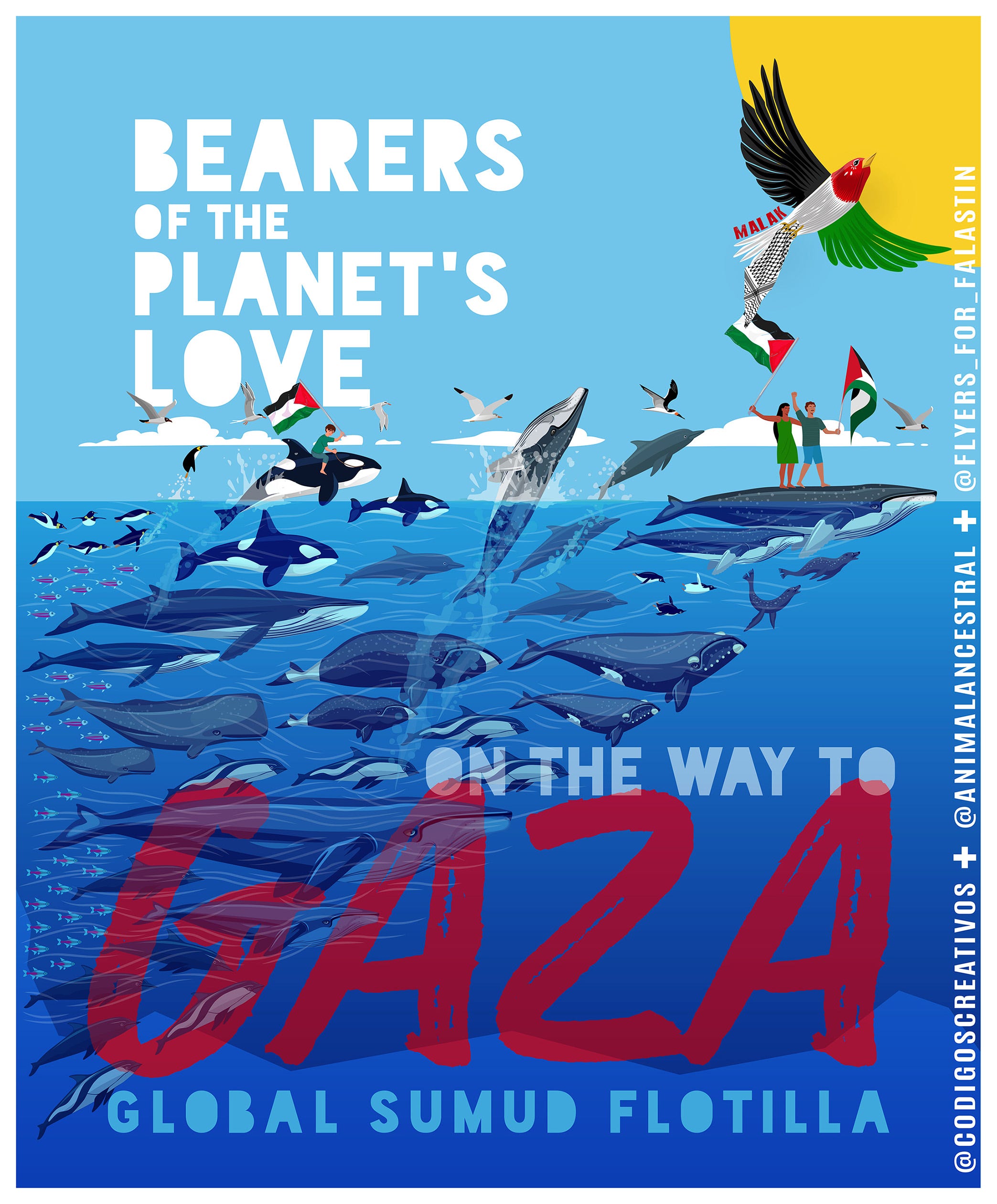
Illustration by Mauricio Labarca Abdala (@animalancestral, @codigoscreativos). Source: Flyers for Falastin (2025).
How we would wish to write here that marine science institutions are an active part of this resistance. That they have deployed their arsenal of maritime equipment to break the naval blockade. That they have mounted their research vessels, their RIBs, their underwater robots, their gliders, their UAVs and USVs with humanitarian aid to break the siege. That they have silenced von der Leyen’s greenwashing speeches with incessant Free Palestine and EU shame on you chants. That they have redirected their research funding to the rebuilding of Palestinian education and science facilities. That they have terminated their purchases from Dell and Microsoft and any company contributing to and profiting from genocide. That they have filed legal cases for blatant violations of the law of the sea. That they are part of the network of solidarity that is building another future by resisting the depravity of the present.
Instead, after 32 months of genocide, we find ourselves writing an appeal for the bare minimum to end complicity.
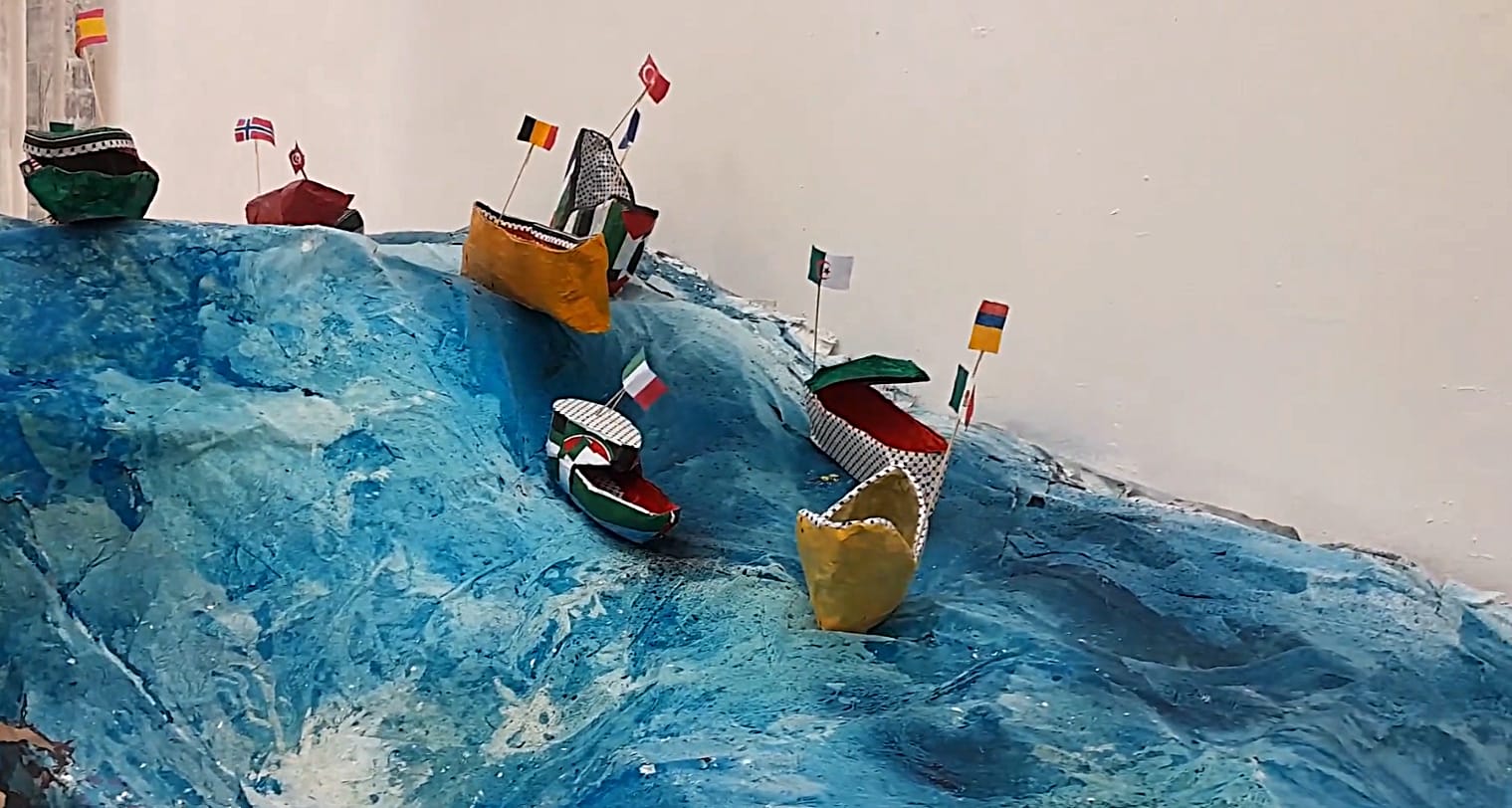
Image of artwork by Bea Vandewalle and Ester Aragones (2025).
High time to take a stand
“Palestine is a mirror held up to the world’s moral and political failures,” says UN Special Rapporteur Francesca Albanese.40 This genocide and the tormenting collective failure to stop it, have exposed the hypocrisy of ‘Western’ society’s institutions.41 The media fail(ed) to contextualise ‘the complicated conflict’ as a settler-colonial war. Governments fail(ed) to break relations with Israel and instead unleashed their law enforcement - equipped with Israeli-made arms and surveillance equipment - on peace activists. Academic institutions fail(ed) to stop collaborating with Israel, resorting to intimidation and police violence to silence students’ and researchers’ opposition to this complicity.42
These institutional failures are not flaws, but foundations rooted in White-supremacist imperialism, patriarchy and capitalism. These policies are nothing but neoliberal necropolitics that do not even bother to pretend they will bring us anything other than one miserable crisis after another.
In the face of a genuine marine biodiversity crisis and global environmental catastrophe, we are being handed “blue growth”, Mission Ocean and the European Green Deal. Lacking any sort of meaningful accountability, these policies represent verbose distractions at best and green capitalist nightmares at the likeliest. Whilst providing no credible approach for safeguarding actual life in the ocean, Mission Ocean promises us a Digital Twin of the Ocean. The current European policy for securing a sustainable future involves pillaging minerals and other ‘resources’ from the Global South to build wind farms in militarised seas where Israeli-manufactured FRONTEX drones collaborate in illegal pushbacks of people fleeing places impacted by these types of policy.43 If the reality of late stage capitalism wasn’t so bleak and violent, it would merely be ridiculous. When deciding to study marine conservation science, no one actively chooses to be part of this dystopian framework. Most of us have been trained uncritically in Western environmentalism, and it is an unsettling process to understand it as an active part of the racial capitalism that produces the environmental destruction one seeks to stop by studying conservation science in the first place.44 The stance towards oppression therefore shapes the framework in which one engages with conservation science. The stance towards genocide is not an ancillary matter in a scientific practice - it is foundational to it:
What is the point of research for ‘restoring the health of the ocean, seas, and inland waters’ when Israel is committing outright ecocide in the coastal Gaza strip?
What is the point of studying the human health benefits of living by the sea when a coastal population of 2.3 million is being exterminated?
What is the point of promoting ‘a carbon-neutral & circular blue economy’ when Israel bombs Gaza’s economy to shreds with 200,000 tonnes of explosives?
What is the point of securing marine food sources for the future when Gaza is being forcibly starved?
What is the point of developing participatory marine governance approaches when anyone who enters the sea in Gaza can be shot at?
What is the point of investigating pollution reduction when Israel destroys Gaza’s sewage system and airbursts white phosphorus over Gaza port and southern Lebanon, scorching and poisoning the earth and sea and all the life that dwells in them?
What is the point of researching maritime law when Israel can blatantly violate countless international legal frameworks (including UNCLOS) without any meaningful consequence?
Truly ask yourself: What is the point of studying life sciences at institutes involved in a politics of death?
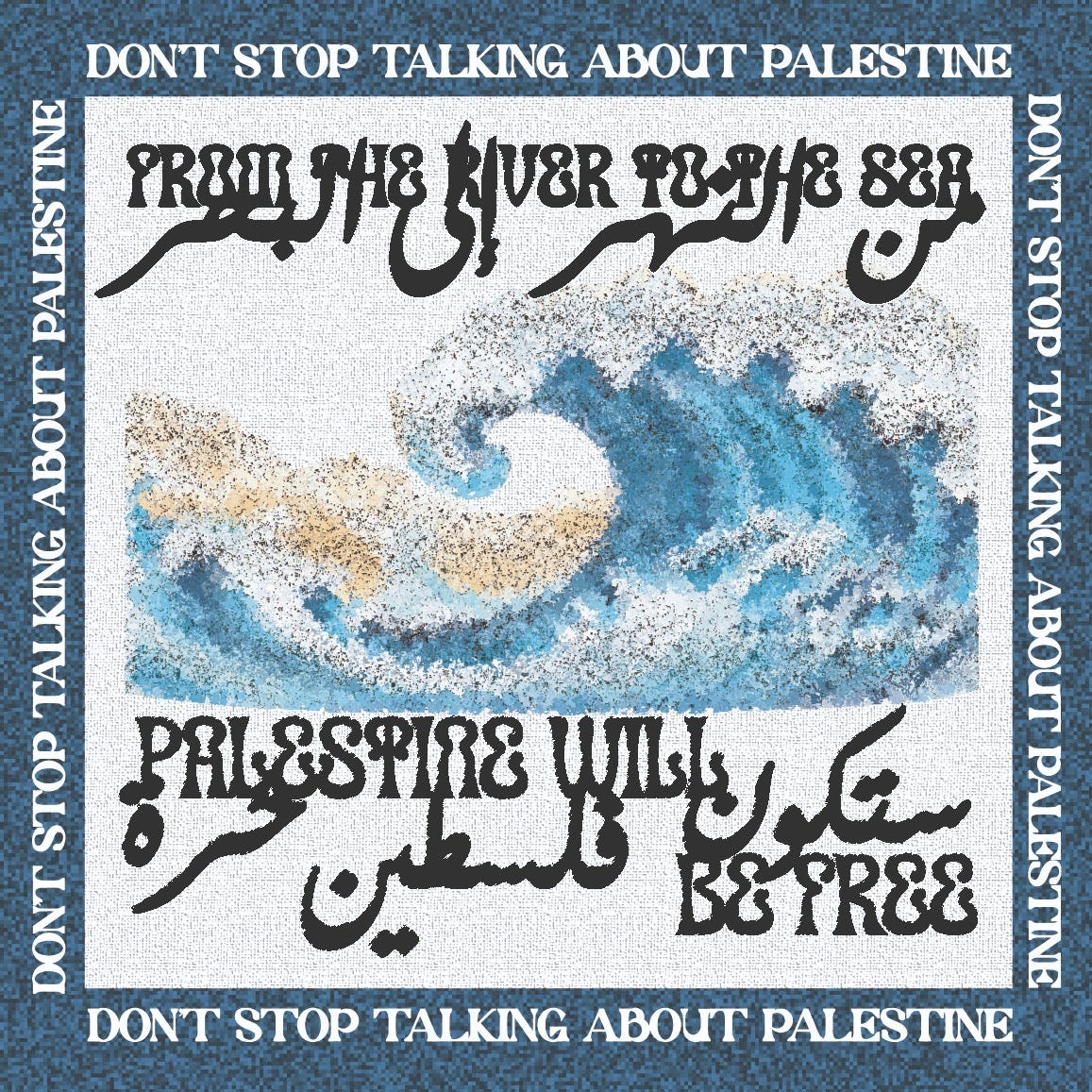
Illustration by anonymous artist. Source: Flyers for Falastin (2024).
The call for stopping academic complicity is targeted at the institutional level, but you – the reader – are a person. And writing this to an actual person, the question does come up: how does a person bear to be part of this? Having had many discussions with ex-colleagues on diverse aspects of institutional rot, the recurring argument seems to be that one is changing the institution from the inside. Surely, there is a convincing logic behind this stance, but has the current reality not superseded this argument? In One day, everyone will always have been against this, Omar El Akkad writes: “It is an admirable thing, in a politics possessed of a moral floor, to believe one can change the system from the inside, that with enough respectful prodding the establishment can be made to bend […] toward justice. But when, after decades of such thinking, decades of respectful prodding, the condition one arrives at is reticent acceptance of genocide, is it not at least worth considering that you are not changing the system nearly as much as the system is changing you?”45 The uncomfortable truth is that the alternative of saying no to complicity, is saying yes to it.
Much of the research and writing that went into this text was written nearly a year ago. We, the authors of this piece, had already left these institutions precisely because we experienced them as rife with neoliberal ideology, ludicrous abuse of power and complacent cowardice. At the time, we did not believe the message could be meaningfully heard. In the 11 months since, Israel has bombed Lebanon, Iran, Yemen, Syria, Tunisia, Qatar, and of course Palestine, as well as brutally amping up its colonization of the West Bank. It has taken captive thousands of Palestinians in prisons notorious for any kind of physical, psychological and sexual torture (un)imaginable. Just last month, it has unlawfully kidnapped hundreds of activists in international waters. Today, we are equally distrusting of the institutional capacity for integrity as before, but defeatism is intolerable in the present reality.46
“No is not a lonely utterance,” writes Sara Ahmed on confronting institutional violence.47 Saying No matters, even if the No is hardly heard. Saying No matters regardless of the anticipated - predictably shitty - institutional response. Saying No creates new coalitions that one day may create the new institutions we need.
From the river to - and including - the sea, Palestine will be free.
eddies
Recommended reading:
Oppressive Pines: Uprooting Israeli Green Colonialism and Implanting Palestinian A'wna by Ghada Sasa in Politics (2023; 43(2), 219–235)
Impact of the Israeli military activities on the environment by Mazin Qumsiyeh in International Journal of Environmental Studies (2024; 81(1): 1-16)


See Gaza genocide: a collective crime - Report of the Special Rapporteur on the situation of human rights in the Palestinian territories occupied since 1967 by Francesca Albanese for the United Nations General Assembly (2025, A/80/492), as well as the Boycott Divestment and Sanction movement.
See Israel’s Universities Are a Key Part of Its Apartheid Regime by Maya Wind in Jacobin (2024), as well as the book Towers of Ivory and Steel: How Israeli Universities Deny Palestinian Freedom (2024, Verso) by the same author. For further information on Israeli academic institutions’ specific involvement, we refer to the Boycott Divestment and Sanction movement.
See From economy of occupation to economy of genocide - Report of the Special Rapporteur on the situation of human rights in the Palestinian territories occupied since 1967 by Francesca Albanese for the United Nations Human Rights Council (2025, A/HRC/59/23).
Legal action has been undertaken to hold the EU accountable for not yet having suspended the Association Agreement. See Lawyers file case against EU Commission and Council for ‘failure to act’ on Gaza genocide by Maria Maggiore on EUobserver (2025). The UN has repeatedly called for the suspension of the association agreement: see for example UN experts call for immediate suspension of EU-Israel trade agreement as ‘minimum requirement’ under international law on OHCHR (2026).
The use of the word ‘our’ illustrates how marine environmental policy fits into the European Commission’s current narrative of ethnic / cultural regionalism, in parallel to “Promoting our European way of life: Protecting our citizens and our values” (EC priorities 2019 – 2024), “Strengthening our common borders” and “Sustaining our quality of life” (EC priorities 2024 – 2029). As is well documented, the European idea to restore our waters is mirrored by its exploitation of waters abroad. See for example EU accused of ‘neocolonial’ plundering of tuna in Indian Ocean by Karen McVeigh in The Guardian (2021) or From Science to Conscience: The Plunder of Senegal’s Fisheries Resources, or Europe’s Role in the Making of a Migration Crisis by Daniel Pauly et al. in Proceedings of the Paris Institute for Advanced Study (2025: 21). To learn more about the ethnic / cultural idea of European identity and how this relates to the broader European relation to empire, we refer to Eurowhiteness: Culture, Empire and Race in the European Project by Hans Kundnani (2023, Hurst Publishers).
The EU-funded Perivallon project ran from 2022 to 2025 and included the TAMAR Group, an Israeli company specialised in explosives technology. The project also included De Watergroep, one of the main Belgian drinking water companies.
According to Mission Ocean’s Portfolio Dashboard, there are still 17 active projects with Israeli partners, partnering with for example IFREMER, Deltares and AWI.
See for example Israeli Practices towards the Palestinian People and the Question of Apartheid by the UN Economic and Social Commission for Western Asia (ESCWA, 2017) and the previously referenced From economy of occupation to economy of genocide - Report of the Special Rapporteur on the situation of human rights in the Palestinian territories occupied since 1967 by Francesca Albanese for the United Nations Human Rights Council (2025, A/HRC/59/23). The latter report highlights the need for accountability and legal consequences for corporations and institutions profiting from genocide.
See for example Europe Showcases AI-Powered Digital Twin of the Ocean as a Major Outcome of the European Ocean Pact by the Flanders Marine Institute (2025).
The complaint to the International Criminal Court was filed in 2024 by the Geneva International Peace Research Institute (GIPRI) and is under investigation. See European Commission president accused of complicity in Israel’s war crimes at ICC on Middle East Monitor (2024). See also Francesca Albanese: ‘EU officials must face charges of complicity in war crimes’ by Emma Sofia Dedorson on EUobserver (2025).
See Ursula von der Leyen’s social media communication on 15 June. The specific context of the phone call was the Israel-Iran war in June 2025, which Israel initiated on 13 June by air striking several sites in Iran. Since 2 March 2025, Israel had been blocking all humanitarian aid from entering Gaza, thus enforcing starvation. Compliance with the ICC is mandatory under EU law, whereby non-essential contact with individuals subject to an ICC arrest warrant should be avoided (Council ST 12090/11).
This list was compiled to the best of our knowledge, with the aim of keeping a marine scope. For details on the collaborations, we refer to the project websites: ANERIS, EMBRC, EMO BON, EMODnet (IOLR, Geological Survey of Israel), Iliad Digital Twin, DTO-BioFlow, EUREMAP and ETN. If you know of any other ongoing projects, get in touch and we can update the table. An ongoing non-marine Mission Ocean project worth mentioning is Water4All, which addresses “Water Security for the planet”. In this large project, the main Belgian research funding agencies FWO and FNRS partner, as well as the Flemish Environment Agency (VMM), partner with the Israeli government which controls the water sources in the West Bank and systematically destroyed water access in Gaza.
See Open letter by Gaza academics and university administrators to the world on Al Jazeera (2024), as well as An open letter from the presidents of Gaza universities by Ayman Sobh, Omar Milad and Asad Asaad on Al Jazeera (2025).
See The banality of scholasticide: the role of universities and academia in an age of genocide by Wadee Alarabeed on Globalisation, Societies and Education (2025: 1 – 16) and Gaza children risk snipers to attend tent schools by Mohammad Mansour and Shady Shamieh on Al Jazeera (2026).
See No honor in complicity: an open letter to our universities by Belgian Universities for Palestine (2026). The open letter states four specific demands: 1) end all existing collaborations with Israeli institutions and with any complicit company, 2) impose an immediate moratorium on new collaborations under current conditions, 3) act collectively at the European level and 4) actively contribute to the survival and rebuilding of Palestinian higher education.
See Even the seas are caged: Palestine’s coastal areas under occupation by Lowell Iporac in Science for the People (2024).
Article II of the 1948 Convention on the Prevention and Punishment of the Crime of Genocide defines genocide as “acts committed with intent to destroy, in whole or in part, a national, ethnical, racial or religious group”, including “deliberately inflicting on the group conditions of life calculated to bring about its physical destruction in whole or in part”.
For an overview of these processes, we refer to the books As Long as Grass Grows. The Indigenous Fight for Environmental Justice, from Colonization to Standing Rock by Dina Gilio-Whitaker (2019, Beacon Press) and An Indigenous Peoples’ History of the United States by Roxanne Dunbar-Ortiz (2014, Beacon Press). Although these works address the five centuries of settler colonialism in the ‘Americas’ (with a major focus on the ‘United States’), the described patterns are largely common to settler colonialism as a system. Moreover, these works powerfully contextualise the ongoing US imperialism.
For an extensive overview of environmental impacts (during military conflict, as well as before and after), see Impact of the Israeli military activities on the environment by Mazin Qumsiyeh in International Journal of Environmental Studies (2024; 81(1): 1-16).
See Environmental harm resulting from Israeli bombing of Gaza by Joni Aasi in Arab Studies Quarterly (2025; 47(1): 27-43).
See Oppressive Pines: Uprooting Israeli Green Colonialism and Implanting Palestinian A’wna by Ghada Sasa in Politics (2023; 43(2), 219–235), Israeli designation of “Nature Reserves”: A tool of colonization by Charlotte Allombert and Mazin B. Qumsiyeh in International Review of Contemporary Law (2024; 6 (4) 9-13) and Wild Legalities: Animals and Settler Colonialism in Palestine/Israel by Irus Braverman in PoLAR (2021; 44, 7-27).
See for example Civil Administration uproots 135 olive trees on privately owned Palestinian land in Wadi Qana – part of Israel’s efforts toward its de facto annexation by B’Tselem (2017) and Ongoing dispossession and a heritage of resistance: The village of Battir vs. Israeli settler-colonialism by Ryvka Barnard and Hassan Muamer in The Politics and Power of Tourism in Palestine (2016; Routledge Isaac RK, Hall CM, Higgins-Desboilles F (eds) 63–78). In No, Israel Is Not Making the Desert Bloom (Jacobin, 2023) Manal Shqair refutes the claim that Israel transformed a barren desert into a blooming oasis, linking the myth to the ongoing resource and energy colonialism Israel inflicts on Palestine and its neighbours through the appropriation of water and energy sources.
See Impact of the Israeli military activities on the environment by Mazin Qumsiyeh in International Journal of Environmental Studies (2024; 81(1): 1-16).
See Settler colonialism and the elimination of the native by Patrick Wolfe in Journal of Genocide Research (2006; 8(4): 387-409). The author theorises how invasion and elimination are structures - not singularities - within settler-colonial societies, and therefore proposes the term ‘structural genocide’ for genocide in the context of settler colonialism.
Adding to the hypocrisy is the fact that wealthy safari hunters can kill the same animals that the indigenous ‘poachers’ are criminalised for hunting. For more information, we refer to read Land grabs and conservation propaganda by Aby L. Sène on Africa is a country (2022), or When conservationists militarize, who’s the real poacher? by Stephen Corry on Survival International (2015).
Notably, the causes of the struggles in Palestine and Kashmir are both rooted in British colonialism. For more information on the replication of the Israeli settler-colonial project in Kashmir, we refer to India, Israel and the ‘greenwashing’ project taking shape in Kashmir by Azad Essa on Middle East Eye (2022), How India is implementing the ‘Israel model’ in Kashmir by Hafsa Kanjwal on Middle East Eye (2024) and Kashmir, spying, demolitions: How Modi’s India embraced ‘Israel model’ by Yashraj Sharma on Al Jazeera (2026). On the military partnership between Israel and India, we refer to India and Israel meet to deepen military ties in sign of solidarity amid Gaza atrocities by Azad Essa on Middle East Eye (2025) and India and Israel’s Military Partnership is Ever-Expanding and Strikingly Opaque by Rahul Bedi on The Wire (2026).
Historical and ongoing examples involve Honduras, Colombia, Brazil, Chile, Haiti and the Philippines, as described in Stop Israeli Weapons Killing Global Environmental Activists by Eitay Mack on Haaretz (2021).
See for example Gaza’s Indonesian Hospital in ruins after Israeli raid, days-long siege on Al Jazeera (2023) and Israel again bombs Gaza’s Beit Lahiya hours after killing 93 in one strike on Al Jazeera (2024).
See Israeli strikes in Gaza kill 9, including aid workers and journalists by Kat Lonsdorf on NPR (2025), Gaza schoolgirl shot dead by Israeli forces ‘in front of other students’ Nidal al-Mughrabi on The Independent (2026) and Gaza children risk snipers to attend tent schools by Mohammad Mansour and Shady Shamieh on Al Jazeera (2026).
See A Mediterranean Sperm Whale (Physeter macrocephalus mediterraneus Khalaf, 2026) washed ashore on Hirbiya (Zikim) Beach, near the northern coastal border of the Gaza Strip, Occupied Palestine by Norman Ali Khalaf in Gazelle: The Palestinian Biological Bulletin (2026; 44(243): 1-35).
The citation originates from Navigating Gaza’s weaponised sea by Aya Bseiso on Shado Magazine (2025). See also Even the seas are caged: Palestine’s coastal areas under occupation by Lowell Iporac in Science for the People (2024). Both pieces powerfully convey the impact and breadth of the maritime occupation. See also the short explainer video How did Gaza’s sea become a wall? on Al Jazeera (2026).
See for example Israel attacked Palestinian fisherman on 320 occasions in 2020 on Middle East Monitor (2021) and Israel navy shoots sewage water at Gaza fishermen on Middle East Monitor (2023).
See Reviving Gaza’s fishing sector hinges on restoring peace and safe access to the sea by FAO (2024), Building to starvation: Systematic attacks on fishing in Gaza and implications for livelihoods and protection by UN OPT Protection Cluster (2025) and It’s Bisan From Gaza – This Is How We Grow Food In A Genocide on AJ+ (2024).
For an overview of Israel’s occupation and plunder of energy resources, see Annexing Energy: Exploiting and Preventing the Development of Oil and Gas in the Occupied Palestinian Territory by Al-Haq (2015), The Economic Costs of the Israeli Occupation for the Palestinian People: The Unrealized Oil and Natural Gas Potential on the United Nations Conference on Trade and Development (2019). For the 2023 concession, see Israeli Gas Exploration Licenses in Palestine’s Maritime Areas Are Illegal and Violate International Law on Adalah (2024).
Under the Oslo accords, the 20 nautical mile zone from the Gaza coastline should fall under Palestinian control. This pipeline is associated with yet another example of European laundering of occupation. To withdraw from Russian gas imports, the EU expanded its gas import from Israel, transported via the illegally constructed El-Arish – Ashkelon pipeline on Palestinian seabed. See EU risks breaching international law over Israeli gas deal, legal experts say on Global Witness (2025).
See for example No Harbour for Genocide on The Palestine Institute for Public Diplomacy (2024), Slovenia: Facilitating the transfer of arms to Israel ‘alarming’ and violates international law on Amnesty International (2025) and Greek ships secretly supplying Israel with oil and military cargo by Oscar Rickett on Middle East Eye (2026).
After the Israeli military illegally seized the Madleen and abducted its crew in international waters, Francesca Albanese called for governments to send their navies with humanitarian aid to uphold their obligation under international law to stop a genocide. See for example the interview with Albanese on Palestine Deep Dive by Ahmed Alnaouq (2025).
See for example French and Italian dockers boycott Israeli arms ship by Arthur Townend on Socialist Worker (2025) and Athens dockworkers obstruct military cargo shipment to Israel by Ana Vračar on Peoples Dispatch (2025). In Belgium, the Vredesactie and other NGOs initiated judicial action to halt shipment of weapons’ components through the port of Antwerp, which is documented at From Antwerp to Ashkelon: No harbour for genocide on BDS (2025) and Major EU port ordered to stop arms shipments to Israel by Andrew Rettman on EUobserver (2025).
See A ship called Madleen: Gaza’s first fisherwoman inspires solidarity mission on Al Jazeera (2025).
See Bulletin on action by UN System and Intergovernmental Organizations relevant to the question of Palestine by the Committee on the Exercise of the Inalienable Rights of the Palestinian People (2025).
“Israel’s current genocide against 2.3 million Palestinians in the besieged and occupied Gaza strip is armed, funded and shielded from accountability by a colonial, hypocritical Western establishment, governments, corporations and institutions, creating a new paradigm where ‘might makes right’ prevails, unmasked and uncontrolled by international law or moral principles.” - Omar Barghouti at The Palestine Festival of Literature (2024).
For some examples in Belgium, see Les étudiants pro-palestiniens expulsés par la police du bâtiment occupé à l’ULB on RTBF (2024), UGent en KULeuven sturen politie af op eigen studenten: “Deze disproportionele reactie is onaanvaardbaar” on De Wereld Morgen (2024) and the opinion piece Bezetting UGent: bondgenoten laat je niet achter na de arrestaties by Polle Griotto on De Wereld Morgen (2026).
See for example Fisheries management, energy and human migration in West Africa should be considered together in a holistic social and ecological systems framework by Marcos Llope, Babacar Diop and Sandra Kloff in ICES Journal of Marine Science (2025: 5, fsag069). We also refer to the Camcopter manufactured by Israeli Aerospace Industry colleague Schiebel, now operational in the Belgian part of the North Sea to enforce border control.
We refer to Ghada Sasa’s description of Western environmentalism, as “the weaponisation of ecological discourses and practices for the achievement of White supremacist, patriarchal, and capitalist aims.” They contextualise Israeli green colonialism in the broader context of Zionism, as well as Western Environmentalism in Oppressive Pines: Uprooting Israeli Green Colonialism and Implanting Palestinian A’wna in Politics (2023; 43(2), 219–235).
See the book One day, everyone will always have been against this by Omar El Akkad (2025, Knopf). The title references a tweet by El Akkad in October 2023: “One day, when it’s safe, when there’s no personal downside to calling a thing what it is, when it’s too late to hold anyone accountable, everyone will have always been against this.”
In reference to the writer Nadeem Aslam’s “Despair has to be earned. I personally have not done all I can to change things. I haven’t yet earned the right to despair,” the BDS movement calls to continue building hope in order to counter despair: “We ask you to persist, unless you have exhausted all possible means to end complicity.” See Channeling Our Grief and Rage, We Rise For Liberation! by the Palestinian BDS National Committee (BNC) on BDS (2024).
See Sara Ahmed’s book No is Not a Lonely Utterance, The Art and Activism of Complaining (2025, Penguin Books Ltd), as well as their Substack post describing the choice for the title (2025, feministkilljoys).